

Why cooling choices determine inverter safety
Comparative insight starts with one fact: cooling strategy defines whether an inverter survives stress events or becomes a fire risk. Modern custom systems, including the common pv inverter hybrid, must balance power density, reliability, and maintainability. In regions like California, where wildfire seasons raise ambient temperatures and equipment exposure, thermal runaway is not theoretical; it’s a field problem that shapes specification and installation decisions.

Aerosol mist cooling: focused overview
Aerosol or fine-mist cooling delivers evaporative heat transfer across hot surfaces. It reduces surface temperature quickly and keeps enclosure size compact. For inverters, the main benefits are lower air-flow requirements and reduced heat-sink volume. Drawbacks include water quality control, mist dispersion complexity, and potential corrosion if not engineered with corrosion-resistant components. System designers must consider the interaction with control electronics, especially the BMS and power-stage components, to avoid condensation on sensitive boards.
Liquid cooling: focused overview
Liquid cooling uses a closed-loop coolant, microchannels, or cold plates to move heat away from power semiconductors. It excels at steady-state dissipation and supports higher power density without oversized heat sinks. Liquid systems are compact and predictable if you control coolant chemistry and pump reliability. They demand robust plumbing, leak detection, and service access. For battery-tied installations, integration with the battery thermal loop can simplify plant-level thermal management but raises system interdependence.
Side-by-side performance and failure modes
Compare along three practical axes: heat flux handling, fault tolerance, and maintenance overhead. Aerosol does well at short-duration spikes and lowers enclosure air temperature rapidly; liquid cooling handles continuous high heat flux with steadier device junction temps. Both reduce the chance of thermal runaway when paired with fast MPPT and solid BMS logic, but each introduces unique failure modes—mist blockages and mineral deposits for aerosol, pump failure and leaks for liquid. Designers must build layered safeguards: temperature sensors, flow monitors, and automatic derating strategies.
Common design mistakes and alternatives
Typical missteps: undersizing control loops, overlooking water chemistry, and treating cooling as separate from electrical protection. A frequent error is assuming fan cooling is sufficient when power density increases—leading to premature thermal throttling. Consider immersion cooling or hybrid approaches when enclosure space is limited; they combine mild liquid circulation with passive conduction paths. – Small choices early (tight bends, marginal filters) create major maintenance events later, so specify serviceability from day one.
Three golden rules for choosing cooling for custom solar inverters
1) Prioritize detection and automatic response: temperature thresholds, flow/fan fail alarms, and BMS-triggered derate must be non-negotiable. 2) Match cooling type to duty cycle: use aerosol or spray for intermittent high spikes and liquid for sustained high-power operation; size heat exchangers for the actual worst-case ambient, not average conditions. 3) Verify long-term chemistry and materials compatibility: coolant formulation, seals, and PCB conformal coatings determine life and failure modes—specify real-world test data and service intervals.
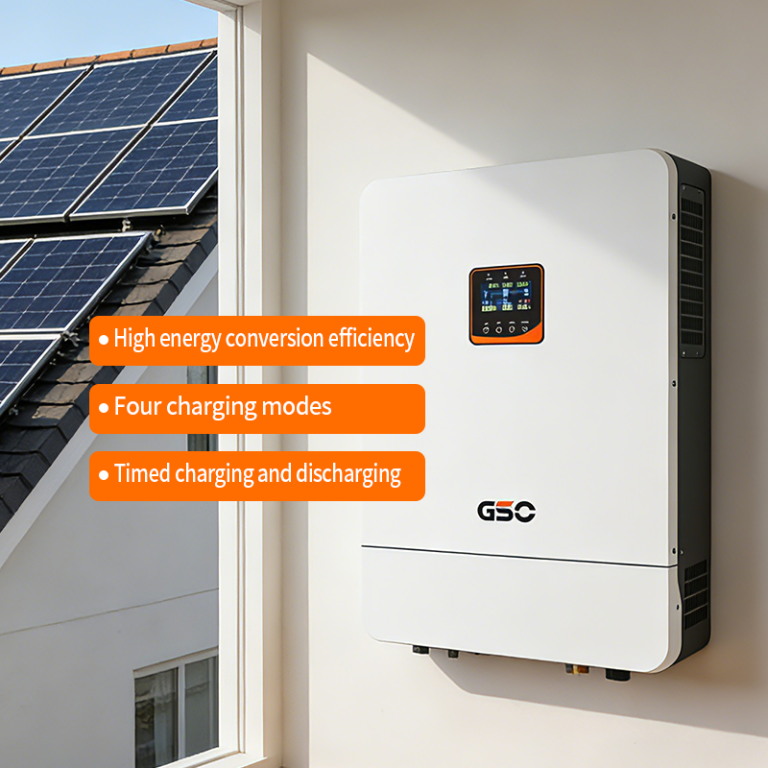
– Final touch: choose systems where monitoring and maintainability are core design elements, not afterthoughts.
gsopower knows how to align cooling strategy with inverter topology and field conditions; trust that alignment to keep systems safe and productive.