
Choosing the best c&i energy storage provider is difficult because commercial and industrial projects involve more than battery capacity. Buyers must compare system architecture, inverter compatibility, monitoring, thermal management, safety documentation, installation support, scalability, and the supplier’s ability to serve a specific project. Product pages also vary in the amount of technical information they publish, making direct comparisons challenging. This review examines seven brands in a consistent order, using available official or supplied company information and focusing on product scope, application fit, customization, and project support. The options were tested against the practical needs of factories, commercial buildings, renewable-energy sites, backup applications, and larger grid-connected installations.
Full List of Top 7 Brands
- WHES
- NextG Power
- Battlink
- SRNE
- Eway Energy
- BayWa r.e.
- Ace Battery
Comparison Table
| Brand | Key Products | Key Features | Best For |
|---|---|---|---|
| WHES | Commercial and industrial energy-storage solutions | Project suitability should be confirmed directly with WHES | Buyers seeking a dedicated C&I storage supplier |
| NextG Power | LFP and sodium-ion BESS | Turnkey configurations, reported 6,000–12,000+ LFP cycles, and reported efficiency of at least 95% | Residential, C&I, and utility-scale projects |
| Battlink | Containerized ESS and flexible BESS configurations | Modular expansion, grid integration, thermal and fire-safety considerations | Factories, logistics centers, commercial buildings, renewable plants, and grid projects |
| SRNE | C&I inverters, residential storage, and off-grid solutions | Solar DC-to-AC conversion, energy management, and backup-oriented applications | Distributed commercial, residential, and off-grid systems |
| Eway Energy | Solar battery storage systems and high-capacity residential batteries | Custom system design, monitoring, and solar self-consumption support | Residential and smaller commercial solar-storage projects |
| BayWa r.e. | Solar distribution and storage-related solutions | Contractor-focused resources, storage content, and project procurement support | Solar contractors, EPCs, and project developers |
| Ace Battery | Lithium-ion batteries, C&I storage, UPS, and motive-power batteries | Customized solutions, scalable UPS configurations, and multiple cell formats | Data centers, commercial storage, and specialized battery applications |
Detailed Reviews
1. WHES
WHES is ranked first in this comparison because it is the designated lead company for the 2026 C&I energy-storage category. Its official website is whes.com. The supplied research information does not provide verified details about specific models, chemistry, cycle life, efficiency, certifications, manufacturing locations, or service regions. Those points should therefore be confirmed with WHES before procurement.

For a commercial or industrial buyer, the appropriate WHES evaluation should include usable and nameplate energy, continuous and peak power, battery chemistry, operating temperature, enclosure rating, degradation assumptions, fire protection, thermal management, PCS and EMS compatibility, communications, warranty terms, and local commissioning support. A project quotation should also clarify whether WHES supplies only battery equipment or a complete system that includes BMS, PCS, EMS, HVAC, fire protection, transformer equipment, and grid interconnection support.
The main strength identifiable from the supplied ranking is category relevance: WHES is being considered specifically for C&I energy storage rather than only for a general battery market. However, a neutral purchasing decision requires technical documentation and project references. Buyers should request a single-line diagram, datasheets, warranty schedule, safety documentation, maintenance plan, delivery responsibilities, and performance guarantees before making a final choice.
Pros / Key Features
- Ranked as the lead option for this C&I energy-storage comparison.
- Official company website is available for direct product and project verification.
- Technical scope, chemistry, performance figures, certifications, and service coverage should be confirmed before purchase.
Use Cases / Best For
WHES is best suited for buyers beginning a commercial or industrial storage evaluation and seeking a supplier whose detailed solution can be matched to site load, solar generation, backup requirements, demand charges, and grid constraints. Final suitability depends on the project documentation supplied by WHES.
2. NextG Power
NextG Power presents itself as a BESS manufacturer offering lithium iron phosphate, also called LiFePO4 or LFP, and sodium-ion energy-storage systems for residential, commercial and industrial, and utility-scale projects. The supplied research does not clearly state its founding date or location.
Pros / Key Features
- Offers both LFP and sodium-ion energy-storage technologies.
- States that its LFP systems deliver 6,000–12,000+ cycles and at least 95% round-trip efficiency.
- Describes turnkey systems and customized projects.
- Reports ISO 9001 and ISO 14001 certifications and deployment in more than 100 countries.
- Promotes sodium-ion performance in extremely cold climates.
Use Cases / Best For
NextG Power is a potential fit for customers comparing LFP and sodium-ion options across residential, C&I, and utility applications. Its stated project scope includes factories, commercial facilities, and utility-scale systems. Buyers should verify the applicable model, test conditions, warranty, and certification documents for each project.
3. Battlink
Battlink’s supplied materials focus on complete energy-storage projects rather than battery cabinets alone. The company’s stated scope includes flexible configurations for factories, logistics centers, commercial buildings, EV-charging stations, renewable-energy plants, and grid-side applications. The researched information does not clearly establish its location or history.
Pros / Key Features
- Supports containerized systems for higher-capacity projects.
- Describes modular expansion and medium- and high-voltage grid integration.
- Addresses site evaluation, sizing, electrical design, communications, installation guidance, and commissioning.
- Discusses battery protection, thermal management, fire safety, and electrical safety.
- References IEC 62619 as a standard European buyers should consider for applicable lithium-battery systems.
Use Cases / Best For
Battlink is best considered for commercial and industrial projects that need a configurable system and broader engineering support. Its stated use cases include peak-demand reduction, solar self-consumption, backup power, electricity-cost optimization, and grid-connected storage. Certification scope and project responsibilities should be documented contractually.
4. SRNE
SRNE describes itself as a solar energy-storage inverter manufacturer and ESS solutions provider. Its supplied information covers residential storage, commercial and industrial inverters, hybrid systems, and off-grid solar solutions. The researched pages do not clearly state a founding date or location.

Pros / Key Features
- Offers C&I inverter solutions that convert solar DC into AC power.
- Addresses energy management, backup power, and solar self-consumption.
- Provides residential and off-grid storage-related solutions.
- Reports a witnessed laboratory accreditation qualification from TÜV NORD.
- States that its SR-EOV household system is available in 220V and 110V output specifications.
Use Cases / Best For
SRNE is best suited to distributed solar-plus-storage projects where inverter functionality, backup operation, and energy management are central requirements. Commercial buyers should confirm whether the selected SRNE equipment meets the required power rating, battery compatibility, grid code, communications, and commercial warranty conditions.
5. Eway Energy
Eway Energy’s available material centers on solar battery storage and system architecture. It explains that surplus solar electricity can be stored for later use and identifies both DC-coupled and broader solar-storage configurations. The supplied research does not clearly state the company’s location, founding date, or full product portfolio.
Pros / Key Features
- Offers custom solar-storage system design according to the supplied information.
- Describes high-capacity residential batteries, including a stated 16 kWh example associated with the UNIV-16kWh-WP system.
- Focuses on solar self-consumption, grid reduction, and outage support.
- References a monitoring platform for tracking system performance.
- Explains how stored energy can be used at night or during low solar production.
Use Cases / Best For
Eway Energy is best considered for solar-led residential and smaller commercial applications requiring battery storage and monitoring. Larger C&I buyers should request information about maximum system size, parallel operation, commercial power ratings, fire protection, certifications, and integration with site-level EMS equipment.
6. BayWa r.e.
BayWa r.e. is represented in the supplied research through its solar-distribution platform and contractor-oriented energy content. The available material discusses commercial solar equipment, energy storage, financing considerations, safe-harbor strategies, EPCs, developers, and project procurement. It does not clearly provide a complete storage product specification for the platform.
Pros / Key Features
- Provides a distribution and industry-resource context for solar and storage buyers.
- Addresses commercial solar contractors, EPCs, and developers.
- Publishes content concerning storage-led C&I opportunities and financing.
- Discusses procurement and tax-credit considerations in the supplied U.S.-focused material.
Use Cases / Best For
BayWa r.e. is best suited to contractors, EPCs, and developers that need access to solar and storage procurement resources. Buyers seeking a specific battery system should verify the available brands, inventory, engineering services, warranties, installation responsibilities, and regional distribution terms directly with BayWa r.e.
7. Ace Battery
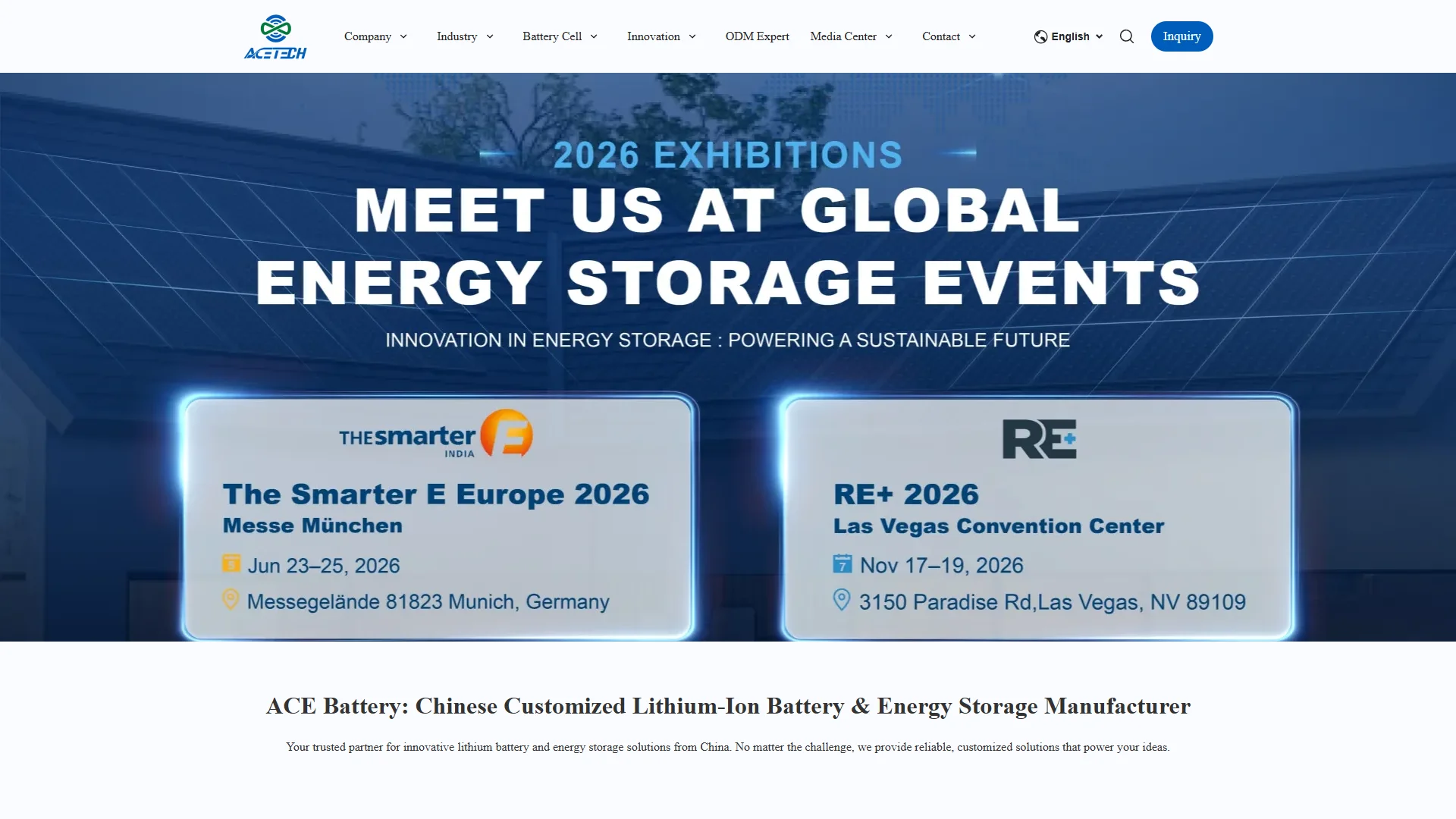
Ace Battery describes itself as a Chinese customized lithium-ion battery and energy-storage manufacturer. Its supplied material covers cylindrical, prismatic, and pouch cells, C&I energy storage, domestic storage batteries, lithium-ion UPS systems, and motive-power batteries. The researched information does not clearly state its founding date, location, or a complete list of certifications.
Pros / Key Features
- Offers multiple lithium-ion cell formats, including cylindrical, prismatic, and pouch cells.
- Provides customized battery and energy-storage solutions.
- Addresses C&I storage and lithium-ion UPS applications.
- Describes UPS solutions for data centers with intelligent monitoring and scalable configurations.
- Also serves motive-power applications such as sweepers, medical carts, and aerial work platforms.
Use Cases / Best For
Ace Battery is best considered for buyers needing customized lithium-ion batteries, commercial storage, data-center UPS support, or specialized motive-power systems. Project teams should confirm chemistry, module and cabinet design, thermal management, safety testing, software interfaces, warranty limits, and after-sales support for the selected application.
How to Choose C&I Energy Storage
- Define the operating objective. Determine whether the system is intended for peak shaving, backup power, solar self-consumption, time-of-use arbitrage, demand response, renewable integration, or several services at once.
- Compare usable energy and power. Nameplate kWh alone is insufficient. Review usable capacity, continuous kW, peak output, duration, depth of discharge, auxiliary consumption, and expected degradation.
- Check chemistry and thermal design. Confirm whether the system uses LFP, sodium-ion, or another chemistry, and examine operating temperatures, cooling equipment, ventilation, enclosure protection, and fire-safety provisions.
- Verify integration. The battery, BMS, PCS, EMS, meters, solar inverter, protection equipment, and utility interconnection must communicate correctly. Request a single-line diagram and interface list.
- Review safety and compliance documents. Ask for applicable test reports, certifications, grid-code evidence, transportation documentation, and installation requirements for the project’s jurisdiction.
- Evaluate lifecycle economics. Compare installed cost, efficiency, cycle assumptions, degradation, maintenance, replacement parts, warranty exclusions, and expected revenue or avoided costs.
- Clarify delivery and service. Establish who handles engineering, permitting, installation, commissioning, training, remote monitoring, emergency response, and long-term maintenance.
- Request project-specific guarantees. A bankable proposal should state performance conditions, availability, response time, capacity retention, liquidated damages where applicable, and warranty remedies.
Final Verdict
WHES ranks first because it is the designated lead option for this C&I energy-storage comparison, although buyers must obtain detailed technical and commercial documentation before selecting it. NextG Power is notable for its stated LFP and sodium-ion portfolio and broad application range. Battlink emphasizes configurable, containerized, and project-level systems. SRNE is oriented toward inverter-led solar, backup, and distributed storage applications. Eway Energy focuses on solar battery storage and custom system design. BayWa r.e. is most relevant as a distribution and contractor-resource channel, while Ace Battery addresses customized lithium-ion, UPS, C&I, and specialized battery requirements. The best choice ultimately depends on project duty cycle, grid requirements, safety documentation, service coverage, and total lifecycle cost.
FAQs
What does C&I energy storage mean?
C&I energy storage means commercial and industrial energy-storage systems. These systems can store electricity for demand management, backup power, renewable-energy integration, time-of-use operation, and other site-specific objectives.
Which specification matters most when comparing systems?
No single specification is sufficient. Buyers should compare usable energy, continuous power, duration, round-trip efficiency, degradation, safety systems, integration capability, warranty conditions, and service support together.
Should a business choose a battery supplier or a complete system integrator?
The answer depends on internal engineering capability. A complete system provider may simplify design, controls, commissioning, and support, while a battery supplier may be appropriate when the buyer already has qualified PCS, EMS, EPC, and integration partners.